Henry Sampson M.S.’61
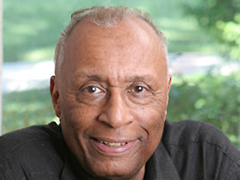
While many strive to make their mark in one particular field, Henry Sampson M.S.'61 has made contributions in numerous fields; as an engineer, inventor and author. From Morehouse College in Atlanta, Ga., he transferred to Purdue University, earning a bachelor's degree in 1956. He then worked as a research chemical engineer at the U.S. Naval Weapons Center in China Lake, Calif. until 1961, an opportunity for which he is thankful because during that time some companies refused to hire African American engineers.
Sampson went on to earn a master's degree in engineering from UCLA in 1961. Four years later, he received a master's degree in nuclear engineering from the University of Illinois at Urbana-Champaign, followed in 1967 by a doctorate in nuclear engineering, becoming the first African-American in the United States to earn a Ph.D. in nuclear engineering.
Sampson's contributions to engineering continued far beyond his education. Shortly after receiving his doctorate, he worked at the Aerospace Corporation in El Segundo, Calif., first as project engineer and then as director of planning and operations at the directorate of space test program. During his time there, he led the engineers launching satellites into space. He also worked as a vanguard engineer, determining how to power satellites.
A prolific inventor as well, Sampson earned a patent with George H. Miley in 1971 for the gamma-electric cell, an invention now used in cell phones. In addition, he holds patents for a binder system for rocket propellants and explosives, and a case-bonding system for cast-composite rocket propellants.
Not only has Sampson made advances in engineering, he has made significant contributions as a film historian, writing about the influence of African Americans in cinema and entertainment in the United States. His books include Blacks in Black and White: A Source Book on Black Films and The Ghost Walks: A Chronological History of Blacks in Show Business, 1865-1910, which examine the sometimes overlooked contributions of African Americans in American cinema. He also produces documentary films on African American filmmakers.
For his outstanding accomplishments, Sampson has been recognized by many organizations throughout his career. In 1964, he earned the Atomic Energy Commission Honor for excellent service at the U.S. Naval Weapons Center. In 1982, the Aerospace Corporation presented him with the Robert H. Herndon Black Image Award, which recognizes African Americans who exhibit professional excellence and leadership. In 1983, the Los Angeles Council of Black Professional Engineers awarded him the Applied Science and Education Award. In 2009, Purdue University recognized him as an Outstanding Chemical Engineer. And in 2012, Sampson received the Entrepreneur of the Year Award from the Friends of Engineering, Computer Science and Technology at California State University, Los Angeles.
Our Proud Partners


