Laura Richardson ’84
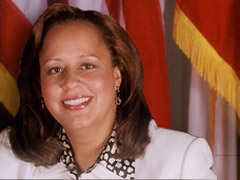
U.S. Rep. Laura Richardson ’84, California District 55, is a powerful player in politics, having served at all three levels of government in a single year.
Richardson was lucky enough to discover her passion at a young age. Growing up during the ’60s, she suffered the discrimination particular to biracial families. She recalls her mother attempting to explain the bizarre behavior of those who disapproved of the family. Richardson’s mother told the six-year-old that she would need to grow up to make better laws. From that day forward, Richardson set her sights upon becoming a member of Congress, citing such outstanding role models as U.S. Rep. Shirley Chisholm, D-New York, who served seven terms spanning three decades, and U.S. Rep. Barbara Jordan, D-Texas, who served from 1973-79.
“It’s great to know that I achieved the dream,” says Richardson.
While studying political science at UCLA, Richardson took an active role in the Black Student Association, helping the organization achieve its goals of making sure that students were aware of programs to help them succeed. She also worked almost full-time, something that was tough at the time but provided her with a life-changing moment during the fall quarter of her sophomore year.
Richardson had just transferred to UCLA from UC Santa Barbara, where she had been a member of the basketball team. She took one of the only available jobs on campus— bussing tables at the Bomb Shelter (a popular eatery located on South Campus).
“I thought it would be cleaning tables and trash, but actually I had to clean both restrooms as well,” she says. “It was a demoralizing experience, but it reminded me about the things ancestors had to go through to make it.”
It was a good lesson for the then-19-year-old, who realized that she’d have to be willing to do whatever it took to maintain the job that helped her be able to afford college.
“One of my crushes would walk by, and I’m cleaning the boys’ bathroom…I learned that it’s not what you wear, or what you think you are, but who you are,” she says, even if one does have a demeaning job.
Luckily, she says, one of her professors spotted Richardson at the eatery and told her of a new job opening with the Beverly Hills Police Department, where she worked for the next two and a half years.
After graduation, Richardson accepted a job as the director of a Montessori preschool, where she worked to increase enrollment. She took a job at Xerox while she completed a master’s degree in business at USC.
“I normally root for UCLA,” she says, “but I have a nephew at ’SC, and I told him that I’d cheer with him while he’s a student. But after he’s a grad, he’s going to have to be a man; I’m going to root for UCLA and I’ll be coming after him!” It’s natural to feel more connected to your undergraduate institute, she says.
Continuing on her path to increased political prominence, she began working part-time for U.S. Rep. Juanita Millender-McDonald. Richardson was elected to the Long Beach City Council, where she served from 2000-2006.
“I joined City Council because I was making a lot of money but something was missing. Parts of the city were impoverished, with a shocking 13.6 percent unemployment rate. I wanted to put money where it’s needed,” she explains.
Richardson arranged for $40 million of development for the city, including a bank, a major grocery store, and a job training and development center, none of which had previously been available to residents.
Richardson also worked under then-Lt. Gov. Cruz Bustamante, where she enjoyed the freedom to work on multiple large-scale issues such as transport, housing, and immigration.
“I was working for the second-highest person in control of the eighth-largest economy in the world,” she points out, “so I gained access to all aspects of state and local government.”
However, Richardson says she could have stayed in local government forever had there not been a two-term limit of eight years on city council. She left that position and was elected to represent the 55 th District in the California State Assembly. She served as assistant pro tem, the first freshman from Southern California to do so. She took on leadership roles, focusing her time on health care, public education and safe neighborhoods.
In April 2007, Rep. Millender-McDonald died in office, and a special election was declared. Richardson succeeded her mentor as the representative for the 37 th Congressional District, which, her biography declares, set a record for distinction in having served all three levels of government: local, state, and federal all in the span of less than a year. The bittersweet decision to run came to Richardson in the midst of a prayer vigil, after a minister laid hands on the attendees, “asking that we [public officials] would have health, wisdom and ability to stand and do our jobs. I understood then that I was the best to represent and understand this community.”
She describes her vision for California as an effort to reclaim the industry—movies, manufacturing and technology, that has been gradually trickling away. “I envision a vibrant economy, with vibrant people in that economy,” she says.
“I grew up believing that America was the best country because it is fair. When people weren’t treated fairly in England, they came here. We’ve lost some of that now. So, when I vote on a bill, I ask myself, ‘Is it fair?’ ‘Is it equitable?’”
Richardson enjoys confronting the increasingly complex issues that appear on the federal level.
“These are big issues,” she declares, citing Guantanamo Bay, No Child Left Behind and wire taps. “There’s an awesome sense of responsibility that differs from city council, where you might vote on whether or not to trim the trees once every three years or every five. Now it’s whether people live or die, whether they have their civil rights violated.”
The best part of being in congress is the ability to change the world, she says. She finds the twice-weekly flights to Washington annoying, but says that she’s adjusting to her new lifestyle.
“I had bought a home in Sacramento, and now, I live in a one-bedroom apartment again when I’m in D.C. But it helps me remember that I’m still a person just like everyone else.”
Our Proud Partners


