Category Archives: Footer
A Big Ten Bruinprint: UCLA’s Bold New Era
A Bold Leap and a Historic Year
When UCLA officially joined the Big Ten Conference on Aug. 2, 2024, it didn’t just shuffle opponents and game times — it stepped boldly into a new era of Bruin athletics.
For nearly 100 years, the Bruins called the Pac-12 home. Leaving behind decades of tradition wasn’t easy, but the promise of sharing the Bruin story nationwide, opening new doors for student-athletes and keeping our programs strong made the leap a bold but thoughtful step forward. Plus, a lucrative annual payout worth between $60 and $75 million made this move too good to pass up.
The stakes were clear: could UCLA carry its legacy of academic and athletic excellence into a conference that stretched coast to coast? In year one, the answer was a resounding “yes,” and then some.
UCLA closed out its debut Big Ten season by finishing fifth in the Learfield Directors’ Cup, an award that recognizes the top overall collegiate athletic programs in the United States, based on their performance in NCAA and NAIA championships. This was the program’s best showing since 2017-18 and a proud reminder that Bruins can thrive anywhere.
Championships, Records and Remarkable Moments
On the field and court, Bruins teams didn’t just compete…they excelled.
UCLA won its 124th NCAA title, the second-most of any university in the nation, when Men’s Water Polo toppled USC, 11-8, in December.
Gymnasts Jordan Chiles and Brooklyn Moors brought home NCAA individual championships on the uneven bars and floor exercise, while the team came in second at the National Championships.
Men’s Volleyball finished second in the nation after advancing to the national final for the third consecutive year.

Nearly 60 Bruins earned All-America honors, with four winning individual national titles.
UCLA was the only school this season to have both softball and baseball teams advance to the College World Series. Men’s Tennis continued its winning tradition by capturing the Big Ten Tournament title and advancing to the NCAA Quarterfinals for the 40th time since the NCAA adopted a bracket format in 1977. UCLA teams won a total of 10 conference titles, most among Big Ten schools.
Bruins fans broke barriers, too. Women’s Basketball set a new single-game attendance record at Pauley Pavilion, with 13,659 fans cheering on the blue and gold on two different occasions, and Women’s Gymnastics also set a program attendance record with 12,918 fans in attendance at the March 9 meet.
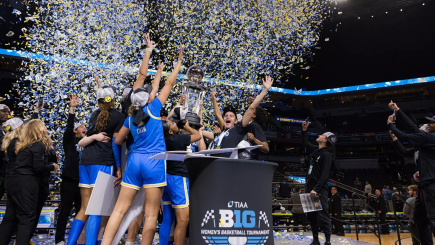
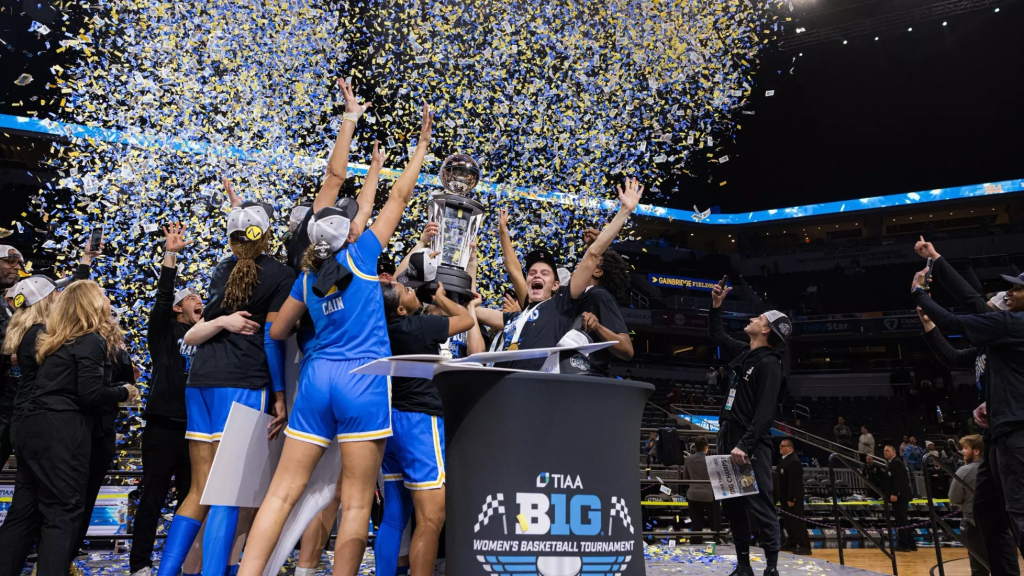
For Women's Basketball, the Bruins' inaugural Big Ten campaign was a historic one. They posted a 34–3 overall (16–2 Big Ten), captured the Big Ten tournament crown, swept major conference honors - including Lauren Betts earning Big Ten Defensive Player of the Year, Sixth Player (Janiah Barker), and First‑Team alongside Kiki Rice - and secured the program’s first Final Four appearance under the NCAA era before falling to national champ UConn.
Men’s Basketball finished their inaugural Big Ten season at 23‑11 (13‑7 Big Ten), tied for fourth in conference play, and bowed out in the NCAA Tournament’s Second Round.
Football’s Big Ten debut put the Bruins on some of college football’s grandest stages. Historic matchups brought thousands of traveling fans, sparked new rivalries and gave our student-athletes the chance to play in some of the sport’s most legendary venues.
Miles Traveled, Lessons Learned
Behind the headlines is a quieter story of resilience and adaptation.
The jump to the Big Ten meant transitioning from the Pac-12’s travel to mostly western schools. Many teams found themselves crossing the country several times a month — some logging more than 20,000 miles in a single year, nearly triple what they’d traveled before.
But instead of letting all that travel slow them down, UCLA’s coaches, staff and student-athletes turned miles into momentum.


Teams stacked back-to-back away games to cut down on extra flights. Travel days doubled as study time. Hotel ballrooms turned into film rooms and pop-up study halls. The added miles tested not just their endurance, but their adaptability, time management and grit.
Investing in Mental Health and Academic Support
The University knew that cross-country travel could add stress and make balancing academics even tougher. That’s why before the first Big Ten whistle blew, UCLA invested in mental health services for student-athletes.
Licensed therapists joined the athletics staff and new programs helped students build better sleep habits, handle jet lag and stay balanced while living out of a suitcase and keeping up GPAs.
Advisors and faculty worked hand-in-hand with coaches to make sure coursework flexed with travel schedules. Online lectures, recorded classes and one-on-one tutoring kept Bruins plugged in, whether in a study hall, at home or an airport terminal halfway across the country.
What emerged was a stronger culture of openness and support, a community that’s helping college athletes everywhere destigmatize mental health.
Bruins spoke up, supported each other and showed that mental well-being is just as vital to success as physical training.
The Power of Community
If the extra miles tested our student-athletes, they also brought the Bruin family closer together. Games in Piscataway, College Park, Omaha and beyond became mini-reunions for thousands of Bruins living in Big Ten country.


To help Bruins rally behind this new chapter, the UCLA Alumni Association carried the spirit of Westwood on the road all season long. On Aug. 2, UCLA Alumni kicked things off with the B1G Event – a launch party celebrating this new chapter in UCLA Athletics history.
Bruin Bash pregame parties and Big Bruin Weekends turned game days into celebrations - from the James West Alumni Center and the Rose Bowl to College Park, Maryland, Piscataway, New Jersey, Omaha, Nebraska and cities across Big Ten territory. Wherever Bruins gathered, there was always a place to reconnect, share stories and get the 8-Clap going before kickoff.


From record crowds at home to loyal fans on the road, Bruins showed what makes UCLA special, no matter where the team plays.
Looking Ahead
This national presence is already paying off. The Big Ten spotlight has amplified UCLA’s Olympic sports, opened new doors for students from the Midwest and welcomed thousands of new fans to the Bruin family.
Being part of the Big Ten has also brought opportunities for alumni to network and learn from our partner schools. This summer, UCLA Alumni will be hosting the Big Ten Alumni Relations Institute (BTARI) at the James West Alumni Center. This three-day conference will welcome alumni relations professionals from across the Big Ten to explore emerging trends, share innovative strategies and build meaningful connections.
Financially, the move kept all 25 varsity programs strong and boosted resources for travel, nutrition and wellness.

There was concern the extra miles would stretch the budget and the athletes too thin. But year one showed that smart planning, strong support and the Bruin spirit can turn challenges into an edge.
The miles aren’t going away, but maybe that’s not so bad.
The systems built this year — from mental health resources to flexible classes — laid the groundwork for even bigger success in year two and beyond.
Final Whistle
A year ago, the Big Ten move felt like a leap into the unknown. Today, as the final whistle has blown following the 2024-25 campaign, it’s now a blueprint for how Bruins can grow without giving up what makes us special: championship ambition, student-first values and a family that shows up — whether the team is playing at home or 2,800 miles away.
Bruins didn’t just adapt; they excelled. They brought home trophies, broke attendance records, raised the bar for mental health and proved success is about more than wins and losses. It’s measured in study sessions on late-night flights, in professors who work with deadlines across time zones and in teammates who lift each other up through long road trips.
Most of all, it’s measured in the unshakable spirit of Bruins everywhere…a reminder that wherever we play, we play together, for each other and for UCLA.
Recent Articles
- Big Ten® Alumni Relations Institute (BTARI) 2025 - Day 1

- A Big Ten Bruinprint: UCLA’s Bold New Era
- Grad Cap Contest Winner - 2025
- A Big Ten Bruinprint: UCLA’s Bold New Era
- Mary Nguyen M.P.P.’23, M.S.W. ’23: Championing Social Justice and Policy Reform

- Travel Journal - Cruise The Heart Of Europe 2025

Grad Cap Contest Winner - 2025
Congratulations Anoushka Bhat '25
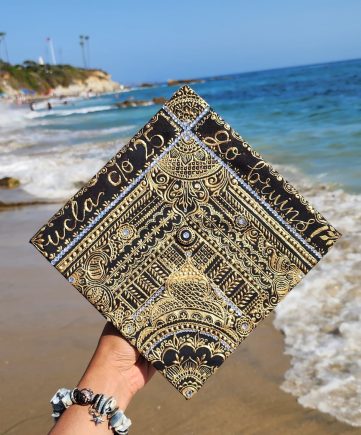
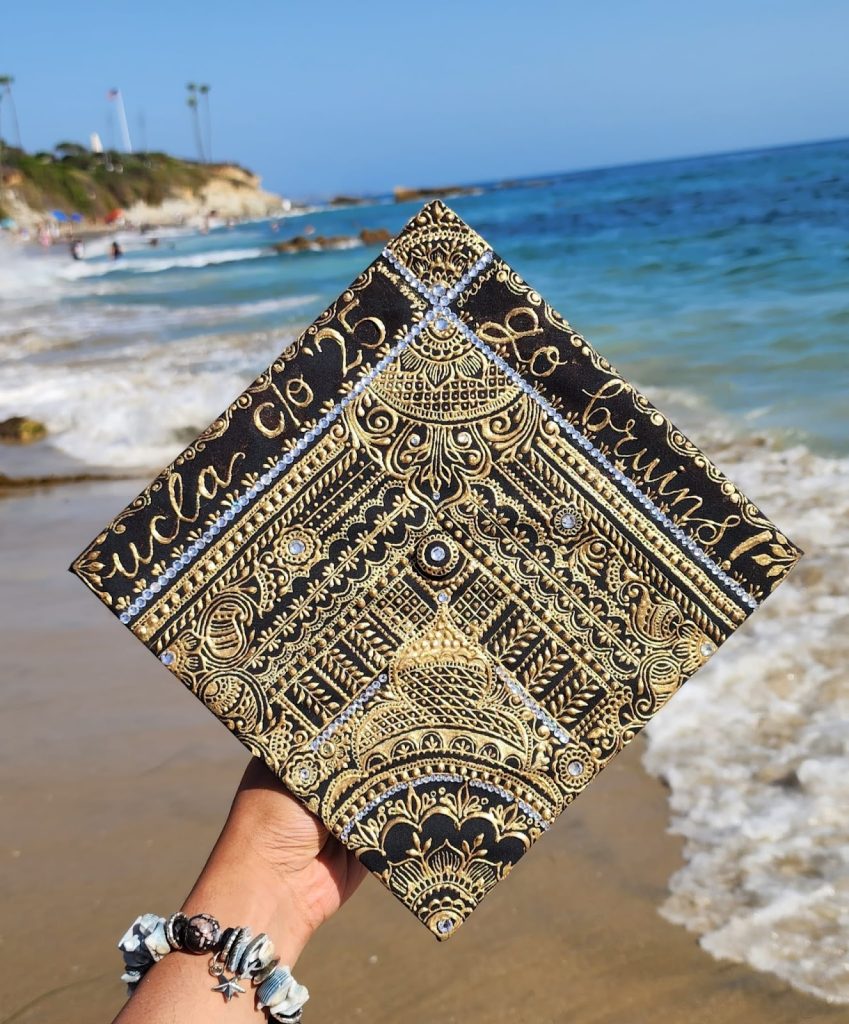
"During my freshman year at UCLA, I founded Henna with a Heart, a club dedicated to sharing the art of henna with my fellow Bruins. What began as a small group of students quickly grew into a vibrant community cherished by many across campus. Through this organization, I developed as a leader, built lasting connections and truly found my home at UCLA. This graduation cap is a tribute to that journey. Decorated with dimensional fabric paint and rhinestones that echo the intricate patterns of henna art, my grad cap symbolizes the creativity, culture, and community that defined my UCLA experience."
Thank you to Wescom, the official banking partner of the UCLA Alumni Association, for sponsoring this contest. The winning grad cap was selected by UCLA Alumni Association staff via voting for submissions which remained anonymous. The winner will receive a $500 UCLA Store gift card.

Honorable Mentions
Rose Saubel ʼ25

“I am an enrolled member of the Torres Martinez Desert Cahuilla Indians tribe, and we traditionally bead our graduation caps and wear feathers to represent our heritage and to honor our ancestors. I designed and hand-beaded my own cap which includes several thousand size 11 beads that were stitched down every two beads apart. The edge design of the cap was inspired by my late father's favorite beadwork that he would usually wear on his hats. The blue triangles represent the mountains within my ancestral lands located within the Coachella Valley. I strategically designed three blue mountains on each side to represent my little family including my daughter, my husband and myself. The top part of my cap includes a rose to honor my late Grandma Rose, who I was named after. She was a matriarch of my family but sadly passed away before I could meet her. I dedicate my cap to my late father, family, ancestors, tribe and all of Indian Country as I would not be here without their support and resilience.”
Dulce Lopez Hernandez ʼ25

“This cap represents more than a degree — it symbolizes resilience, dedication and the unbreakable bond between a mother and her daughter. As a first-generation student, becoming pregnant during undergrad was never part of the plan, but life’s timing had its purpose. Against the odds and despite the doubts, I pushed forward. This is for my daughter, who gave me the strength to keep going.”
Jacquelyn Chau ʼ25

“My graduation cap is dedicated to the people who have stood by me every step of the way: my family. Throughout my two years at UCLA, they have been my constant support system and have been there for me through everything. The quote ‘Did it for them’ is a tribute to my parents and grandparents, who are immigrants from Vietnam.
After the Vietnam War, they made the dangerous choice to escape by boat, leaving behind everything they knew in hopes of a better life. They came to the U.S. with nothing but resilience and dreams for a brighter future. It’s because of their sacrifices, strength and love that I’ve had the opportunity to be here at UCLA and succeed in school.
This cap is for them. It’s for their journey, their hopes and the future they made possible for me. I carry their story with me always, and I graduate not just for myself, but for my whole family.”
Sloane Shevin ʼ25

“I specifically chose this movie focused “La La Land” design for a number of reasons. One is because the film is easily one of my favorite films of all time. Since first watching the movie, “La La Land” has been a film I consistently go back to, reminding me that even though plans and paths may change, you can never give up on your dreams. My two dreams in life were to get into UCLA and be in the film industry. Now, both of these goals have been accomplished, it felt very fitting to have that represented on my graduation cap. I also added a few additional "UCLA" touches to the design including Joe Bruin replacing Ryan Gosling from the original poster (with a "25" on his jersey to represent my graduation year), Royce silhouetted in the background, the iconic UCLA lamppost, and of course combining the film name with UCLA.
Momoka Yoshida ʼ25

“I love Snoopy and mushrooms. And I displayed Snoopy and mushrooms’ figure toys on a dashboard in front of passenger’s seat. They always watched over me all the way to go to UCLA. Also, every time I gave friends rides, my little cute figures entertained my friends. That is why I decided to put Snoopy and mushrooms picture on my graduation cap with rhinestones. They are my parts of memories of UCLA life.”
Recent Articles
A Big Ten Bruinprint: UCLA’s Bold New Era
A Bold Leap and a Historic Year
When UCLA officially joined the Big Ten Conference on Aug. 2, 2024, it didn’t just shuffle opponents and game times — it stepped boldly into a new era of Bruin athletics.
For nearly 100 years, the Bruins called the Pac-12 home. Leaving behind decades of tradition wasn’t easy, but the promise of sharing the Bruin story nationwide, opening new doors for student-athletes and keeping our programs strong made the leap a bold but thoughtful step forward. Plus, a lucrative annual payout worth between $60 and $75 million made this move too good to pass up.
The stakes were clear: could UCLA carry its legacy of academic and athletic excellence into a conference that stretched coast to coast? In year one, the answer was a resounding “yes,” and then some.
UCLA closed out its debut Big Ten season by finishing fifth in the Learfield Directors’ Cup, an award that recognizes the top overall collegiate athletic programs in the United States, based on their performance in NCAA and NAIA championships. This was the program’s best showing since 2017-18 and a proud reminder that Bruins can thrive anywhere.
Championships, Records and Remarkable Moments
On the field and court, Bruins teams didn’t just compete…they excelled.
UCLA won its 124th NCAA title, the second-most of any university in the nation, when Men’s Water Polo toppled USC, 11-8, in December.
Gymnasts Jordan Chiles and Brooklyn Moors brought home NCAA individual championships on the uneven bars and floor exercise, while the team came in second at the National Championships.
Men’s Volleyball finished second in the nation after advancing to the national final for the third consecutive year.
Nearly 60 Bruins earned All-America honors, with four winning individual national titles.
UCLA was the only school this season to have both softball and baseball teams advance to the College World Series. Men’s Tennis continued its winning tradition by capturing the Big Ten Tournament title and advancing to the NCAA Quarterfinals for the 40th time since the NCAA adopted a bracket format in 1977. UCLA teams won a total of 10 conference titles, most among Big Ten schools.
Bruins fans broke barriers, too. Women’s Basketball set a new single-game attendance record at Pauley Pavilion, with 13,659 fans cheering on the blue and gold on two different occasions, and Women’s Gymnastics also set a program attendance record with 12,918 fans in attendance at the March 9 meet.
For Women's Basketball, the Bruins' inaugural Big Ten campaign was a historic one. They posted a 34–3 overall (16–2 Big Ten), captured the Big Ten tournament crown, swept major conference honors - including Lauren Betts earning Big Ten Defensive Player of the Year, Sixth Player (Janiah Barker), and First‑Team alongside Kiki Rice - and secured the program’s first Final Four appearance under the NCAA era before falling to national champ UConn.
Men’s Basketball finished their inaugural Big Ten season at 23‑11 (13‑7 Big Ten), tied for fourth in conference play, and bowed out in the NCAA Tournament’s Second Round.
Football’s Big Ten debut put the Bruins on some of college football’s grandest stages. Historic matchups brought thousands of traveling fans, sparked new rivalries and gave our student-athletes the chance to play in some of the sport’s most legendary venues.
Miles Traveled, Lessons Learned
Behind the headlines is a quieter story of resilience and adaptation.
The jump to the Big Ten meant transitioning from the Pac-12’s travel to mostly western schools. Many teams found themselves crossing the country several times a month — some logging more than 20,000 miles in a single year, nearly triple what they’d traveled before.
But instead of letting all that travel slow them down, UCLA’s coaches, staff and student-athletes turned miles into momentum.
Teams stacked back-to-back away games to cut down on extra flights. Travel days doubled as study time. Hotel ballrooms turned into film rooms and pop-up study halls. The added miles tested not just their endurance, but their adaptability, time management and grit.
Investing in Mental Health and Academic Support
The University knew that cross-country travel could add stress and make balancing academics even tougher. That’s why before the first Big Ten whistle blew, UCLA invested in mental health services for student-athletes.
Licensed therapists joined the athletics staff and new programs helped students build better sleep habits, handle jet lag and stay balanced while living out of a suitcase and keeping up GPAs.
Advisors and faculty worked hand-in-hand with coaches to make sure coursework flexed with travel schedules. Online lectures, recorded classes and one-on-one tutoring kept Bruins plugged in, whether in a study hall, at home or an airport terminal halfway across the country.
What emerged was a stronger culture of openness and support, a community that’s helping college athletes everywhere destigmatize mental health.
Bruins spoke up, supported each other and showed that mental well-being is just as vital to success as physical training.
The Power of Community
If the extra miles tested our student-athletes, they also brought the Bruin family closer together. Games in Piscataway, College Park, Omaha and beyond became mini-reunions for thousands of Bruins living in Big Ten country.
To help Bruins rally behind this new chapter, the UCLA Alumni Association carried the spirit of Westwood on the road all season long. On Aug. 2, UCLA Alumni kicked things off with the B1G Event – a launch party celebrating this new chapter in UCLA Athletics history.
Bruin Bash pregame parties and Big Bruin Weekends turned game days into celebrations - from the James West Alumni Center and the Rose Bowl to College Park, Maryland, Piscataway, New Jersey, Omaha, Nebraska and cities across Big Ten territory. Wherever Bruins gathered, there was always a place to reconnect, share stories and get the 8-Clap going before kickoff.
From record crowds at home to loyal fans on the road, Bruins showed what makes UCLA special, no matter where the team plays.
Looking Ahead
This national presence is already paying off. The Big Ten spotlight has amplified UCLA’s Olympic sports, opened new doors for students from the Midwest and welcomed thousands of new fans to the Bruin family.
Being part of the Big Ten has also brought opportunities for alumni to network and learn from our partner schools. This summer, UCLA Alumni will be hosting the Big Ten Alumni Relations Institute (BTARI) at the James West Alumni Center. This three-day conference will welcome alumni relations professionals from across the Big Ten to explore emerging trends, share innovative strategies and build meaningful connections.
Financially, the move kept all 25 varsity programs strong and boosted resources for travel, nutrition and wellness.
There was concern the extra miles would stretch the budget and the athletes too thin. But year one showed that smart planning, strong support and the Bruin spirit can turn challenges into an edge.
The miles aren’t going away, but maybe that’s not so bad.
The systems built this year — from mental health resources to flexible classes — laid the groundwork for even bigger success in year two and beyond.
Final Whistle
A year ago, the Big Ten move felt like a leap into the unknown. Today, as the final whistle has blown following the 2024-25 campaign, it’s now a blueprint for how Bruins can grow without giving up what makes us special: championship ambition, student-first values and a family that shows up — whether the team is playing at home or 2,800 miles away.
Bruins didn’t just adapt; they excelled. They brought home trophies, broke attendance records, raised the bar for mental health and proved success is about more than wins and losses. It’s measured in study sessions on late-night flights, in professors who work with deadlines across time zones and in teammates who lift each other up through long road trips.
Most of all, it’s measured in the unshakable spirit of Bruins everywhere…a reminder that wherever we play, we play together, for each other and for UCLA.
Recent Articles
- Big Ten® Alumni Relations Institute (BTARI) 2025 - Day 1
- A Big Ten Bruinprint: UCLA’s Bold New Era
- Grad Cap Contest Winner - 2025
- A Big Ten Bruinprint: UCLA’s Bold New Era
- Mary Nguyen M.P.P.’23, M.S.W. ’23: Championing Social Justice and Policy Reform
- Travel Journal - Cruise The Heart Of Europe 2025
Mary Nguyen M.P.P.’23, M.S.W. ’23: Championing Social Justice and Policy Reform
Mary Nguyen (she/her) has always been driven by a passion for community advocacy. Growing up in Garden Grove and later Stanton, she was surrounded by a diverse cultural community that shaped her awareness of social and economic disparities. As a first-generation college graduate, Nguyen pursued a degree in Human Services at Cal State Fullerton before earning dual master’s degrees in Social Welfare and Public Policy from the UCLA Luskin School of Public Affairs.
Her early career in mental health as a housing specialist exposed her to the systemic barriers that many individuals face, particularly those experiencing homelessness. Nguyen worked closely with clients diagnosed with substance use disorders and mental health conditions, assisting them in navigating Section 8 housing and shelter programs. However, she soon realized that despite her best efforts, structural issues within housing policies often prevented real, lasting change.
"There were too many people applying for too few housing opportunities," Nguyen said. "Even when individuals followed every requirement, sudden policy shifts could push them further down the waiting list. It was then that I realized real change happens at the policy level."
This realization led her to UCLA, where she sought to bridge the gap between macro-level policy work and micro-level social services. At Luskin, Nguyen immersed herself in student leadership, becoming chair of the Asian American and Pacific Islander (AAPI) caucus. She also led the Public Policy Leadership Association, stepping into roles that challenged her to advocate on a larger scale.
"I wanted to connect with my identity and my peers," she said. Although there were few Asian American, Native Hawaiian, and Pacific Islander (AANHPI) students in my dual program, there was still a disconnect, where I wanted to foster a greater sense of community and build lasting connections."
Taking on leadership roles was initially outside her comfort zone. "As a Vietnamese woman, I grew up with the expectation to be quiet and not make waves," Nguyen said. "The programs and opportunities at UCLA helped me break out of that mindset. I stepped into leadership, first with the AAPI caucus and later as chair of the Public Policy Leadership Association."
She also participated in the global policy exchange program, Hertie, in Germany, which broadened her perspective on policymaking. "It made me realize how small our world is within the U.S., and how much we can learn from other countries' approaches to governance," she said.

From theory to practice
Nguyen's work at UCLA directly informed her current role as Policy and Research Manager at the California Healthy Nail Salon Collaborative. The organization advocates for social justice issues, particularly for low-income Vietnamese immigrant and refugee nail salon workers.
"Our organization is a statewide grassroots coalition that advocates for social justice issues," Nguyen said. "We provide civic engagement, educational workshops on health and workers' rights, and lead policy campaign efforts."
One of her significant policy efforts was Assembly Bill 2444, known as the Justice in Beauty Bill, authored by Assemblymember Alex Lee. The bill aimed to enhance language access for labor rights materials and required in-language announcements for licensed manicurists when labor laws changed. Though the bill was held in appropriations, Nguyen found the process invaluable.
"It was an empowering experience to mobilize our community members—our 'aunties' as we call them—to Sacramento for lobby days," she said. "They shared their testimonies and learned how to advocate for themselves in legislative meetings."
Nguyen, whose second language is Vietnamese, played a crucial role in ensuring the policy language was accessible to community members. "Policy terms can be jargony, so translating them in a way that maintains their full meaning was a challenge," she said. "But it was necessary to ensure our members understood their rights and could advocate for themselves."
Navigating the Present and Looking Ahead
Nguyen continues to engage in advocacy beyond her work, participating in community actions and rallies. "I find solace in spaces where people understand the work we do," she said. "Being in community spaces, talking about real issues, and engaging in creative outlets like music and drawing helps me navigate these challenging times."
She also advises people to diversify their sources of news. "Western media narratives are often biased, so it's important to seek out diverse perspectives," she said. "Listen to students who are organizing on campus — they're in the belly of the beast when it comes to political activism."
Her advice for those looking to stay informed and engaged is simple: "Support local businesses, engage with your community, and do what you can to make a difference. Even small actions contribute to meaningful change."
Nguyen's journey from social work to policy advocacy exemplifies how grassroots activism can influence systemic change. As she continues her work at the California Healthy Nail Salon Collaborative, she remains committed to uplifting marginalized communities and ensuring their voices are heard in policymaking spaces.
Resources from the CA Healthy Nail Salon Collaborative
How to protect yourself from ICE at your home, in public and in the workplace (English and Vietnamese)
Reports from CA Healthy Nail Salon Collaborative
Recent Articles
- A Big Ten Bruinprint: UCLA’s Bold New Era
- Grad Cap Contest Winner - 2025
- A Big Ten Bruinprint: UCLA’s Bold New Era
- Mary Nguyen M.P.P.’23, M.S.W. ’23: Championing Social Justice and Policy Reform
- Travel Journal - Cruise The Heart Of Europe 2025

- L.A. Wildfires: Stories of Recovery

Travel Journal - Cruise The Heart Of Europe 2025
May 6 - 21, 2025
Photos taken by the tour group

U
UCLA Alumni Travel cruised through the heart of Europe on a 14-night journey along the Rhine, Main and Danube rivers. Bruins explored five countries: The Netherlands, Germany, Austria, Slovakia and Hungary, with stops in iconic cities like Vienna, Budapest and Amsterdam. Alumni enjoyed guided tours, immersive local experiences and stunning scenery, all from the comfort of a first-class river boat.
If you enjoy river cruising through the heart of Europe, you’ll love the Holiday Markets Cruise along the festive Rhine River. Feel the magic of this seven-night journey offering the same first-class experience, this time set against the backdrop of charming towns dressed up for the holidays.
Waterland Bike Ride - Amsterdam, Netherlands

Documentation Center Exhibit - Nuremberg, Germany

Schnitzel Lunch - Nuremberg, Germany

Wurzburg Residenz - Wurzburg, Germany

Walking Tour - Cologne, Germany

Passau - Germany

Cheesemaking Demo - Amsterdam, Netherlands

Apple Strudel Making

Wachau Valley Cycling - Durnstein

Kitchen Tour Aboard Cruise Ship

Recent Articles
L.A. Wildfires: Stories of Recovery
T
he January wildfires were the most destructive in California history, leaving behind immeasurable damage in the Pacific Palisades and Altadena neighborhoods. Last March, our Bruins Helping Bruins article shed light on UCLA’s actions during and in the immediate aftermath of the fires to keep everyone safe and mobilize resources for victims. Today, the neighborhoods impacted by the fires are still being inspected and assessed as displaced residents, many who lost everything, have begun the process to recover and rebuild.
BRUIN STORIES
Within the UCLA community, it is estimated that the fires affected more than 22,000 alumni who were living in the evacuation zones. Each home, each business lost to the fires tells the story of a family. On Jan. 7, Jane Szutu Permaul, Ed.D. ’70, left her house for a doctor's appointment. The UCLA alumna and retired assistant vice chancellor for UCLA Student Affairs has lived in her Palisades home for more than 50 years. By the time she left the doctor’s office, she could see smoke in the distance as her phone exploded with calls and messages.

She went home, grabbed a few essentials, and raced to pick up her daughter in Santa Monica — a 20-minute drive that took two and a half hours. A text alerted her of the evacuation order. She says, “I don't think our house was burned on the first day. I think it just became so overwhelming for the firefighters. The wind was just blowing in such a way it was just ridiculous to even think about saving it.”
She and her daughter stayed with her son who lives in Sherman Oaks. They thought about finding a rental on the Westside, but she says, “It was too difficult. Landlords were hiking up the rates. It calmed down now, but it was just ridiculous.”
Instead of focusing on her loss, Permaul prefers to focus on positive things she can be grateful for. She says, “I believe in positive thinking and problem solving rather than harping on something that you can't do anything about. You lost your house. So, what do you do next? That's how we managed.”
Her Palisades neighbors have been a source of strength. She says they started a group chat, “We call ourselves the loopers, because of the shape of our block. If you need something as minor as a scanner, or as big as a contractor, everybody shares their knowledge and their connections and whatever else is needed to make life easy for all of us.” Eighty percent of the neighborhood plans to rebuild, and she anticipates their bond will be stronger than ever.
Her passport had been destroyed, so she went to the FEMA disaster recovery center at UCLA Research Park (formerly Westside Pavilion). Within 30 minutes, she had completed the application, and the fees had been waived. Her new passport arrived in 10 days.
She says she’s been impressed with how government agencies have coordinated and cooperated to help those in need. The disaster response brought together the federal government, including FEMA and the U.S. Army Corps of Engineers, the governor of California and state senators, as well as county and city officials. These entities have worked together to introduce legislation to expedite the recovery and mitigate the bureaucracy.
Since retiring 24 years ago, Permaul is still active in several UCLA organizations, including UCLA Faculty Women's Club, the UCLA Emeriti Association and the UCLA Retirees Association. She has had an outpouring of support from Bruins. She says, “To this day, I am getting little notes or emails, and sometimes little gifts. I got a box from my former executive assistant that was filled with UCLA swag.”
As a die-hard Bruin basketball fan, she told a story of when she went to a game shortly after the fire. “A friend handed me a bag full of file folders, paper, stamps and envelopes. Soon enough, I had to get things organized, and I was so grateful for the gift. The thoughtfulness helps a great deal in making this easier.” She continues, “I've very seldom received contributions, gifts and donations. I always thought somebody else needs it more than I do. I have learned how important it is to not only give but to graciously receive.”
Allegra Mancuso ’86, M.Ed. ’89, M.A. ’97, Ph.D. ’01, is a quadruple Bruin with a doctorate in education. She and her husband bought their home in the Pacific Palisades in 1993 and raised their family there. With her children now grown and living out of state, Mancuso was home the morning of Jan. 7 with the family dog. She recalls, “From my backyard, I could see little fires across the hill. I thought, this is bad. We have to get out of here.” She took a few pieces of clothing, some personal items and paperwork, along with her Bernese Mountain dog and a large bin of dog food. She also took a photo of her parents and a Madonna and child statue from Italy that had been in her family for generations. She says, “I remember walking through the house thinking we’ll be back tonight or tomorrow.”
They evacuated to her mother-in-law's house, and it was there they learned their home had been destroyed. “First, it's fight or flight. Then you're in disbelief, you're in shock. But the brain is wired for hope. Your brain makes you survive because hope is right there.” Mancuso views her experience with the larger perspective of the many crises happening around the world each day. She says, “I don't have anger. That's the one feeling I don’t have, it's the sadness, the anxiety, the loss and pain.”
Her sister, a doctor in northern California, immediately took off work to come to Los Angeles. She says, “The community was amazing and our friends who don't live in the Palisades came to our rescue. There was a lot of support around, so it felt really kind. But we were the people who always donated, and receiving can be an uncomfortable feeling.”
For her, the loss of her close-knit neighborhood hit the hardest. As the family tried to rent an interim home, she was also faced with skyrocketing rental costs, which sometimes increased overnight. But she has been touched by the outpouring of community support. Boutiques, many locally owned, have offered free clothing and other items to fire victims.
“All the gestures of support make such a difference in lifting your spirits and reminding you that you’re part of a larger community.”
After the fire, they had to determine what their insurance would cover. She says, “My advice is to take photos of everything in your house, and to know where everything is in case of an evacuation. It was incredibly helpful to have photos to send to the insurance company.”
That week, they met friends for dinner. When they asked for their bill, the waiter shared that it had been taken care of by another diner. He told them, “The customer at the neighboring table overheard your conversation and she paid for you. She just wanted to do something to help.”
A few weeks later, she was in the same neighborhood with her sister-in-law shopping for clothes. The store clerk approached Mancuso to let her know that a fellow shopper, a young woman also shopping that day, had overheard their conversation and left a $100 gift certificate for her. She says, “All the gestures of support make such a difference in lifting your spirits and reminding you that you’re part of a larger community.”
To help others, like Permaul and Mancuso, replace their lost Bruinwear, UCLA Alumni is coordinating a Bruin Gear Pop-up on Thursday, June 22, from noon to 5 p.m. at the Pasadena Senior Center, 85 E. Holly Street in Pasadena. Alumni can bring their new and slightly used UCLA apparel for Bruins who lost it all in the fires.
WESCOM’S RELIEF EFFORTS
The Wescom motto is “people helping people,” and with its headquarters in Pasadena, and more than 40% of their members in the communities impacted by the wildfires, providing support was a top priority. As the official banking partner of UCLA Alumni, Athletics, Campus Life and Recreation, Wescom Financial’s charitable foundation stepped up to help.
Immediately following the wildfires, Wescom launched a member and community giving campaign that raised over $273,000 in grants and financial assistance. These funds went directly to supporting people in need, including $9,000 for the Los Angeles Fire Department Foundation; $157,000 for the American Red Cross; and $107,000 in direct relief to victims. They also distributed 75 emergency loans totaling $283,000 and 81 loan deferments. To help their employees who had been directly impacted by the fires, Wescom created an employee relief fund of $100,000.

Beyond the financial support, Wescom's direct involvement in relief efforts comes from their commitment to their community. With their headquarters across the street from the Pasadena Convention Center FEMA disaster recovery site, they were able to spring into action by opening up their parking lot to assist with the substantial number of volunteers and donations arriving. Additionally, their team members volunteered to help coordinate a donation drive at the Pasadena Job Center in collaboration with the Credit Union League. They opened their item processing center and donated apparel, bags, reusable water bottles, mobile chargers, power banks, dog food and lunch for volunteers, along with plush toys, blankets, coloring sheets and crayons for children.
Wescom has stated they intend to make a long-term investment in the recovery, with a sustained commitment to rebuilding and healing.
UCLA EXPERTS
As the rebuilding begins, UCLA experts across campus, from environmental studies and urban planning to medicine, psychology and biology, have been providing analysis, guidance and hands-on assistance with all aspects of fire recovery and rebuilding, as well as pressing ecological and environmental concerns.
Los Angeles County Supervisor Lindsey Horvath Cert. ʼ14 recently announced a blue-ribbon commission that will leverage that UCLA expertise across campus to create policy recommendations for a safe and resilient rebuilding effort.
At the UCLA Samueli School of Engineering, faculty and students are supporting community recovery initiatives that emphasize the need for long-term wildfire resilience strategies and technological innovation. Sanjay Mohanty, associate professor of civil and environmental engineering at UCLA, is working with Community Action Project–Los Angeles to test soil and water samples from yards, gardens and pools free of charge. The program expedites the recovery process while empowering home and business owners. Mohanty is developing climate-resilient solutions for remediating contaminated land and water.
The fires burned for 24 days, and more than 16,000 structures were destroyed. A report from UCLA Anderson economists Zhiyun Li and William Yu suggests that the total losses may be between $95 and $164 billion. They argue for long-term investments in wildfire mitigation to protect from higher insurance premiums, health risks, and unaffordable housing and rental units.
Along with the damage, there remain questions about the fires’ impact on the environment. In Altadena, four months after the wildfires, wildlife is beginning to return to the Eaton Fire burn area. UCLA researchers are monitoring plant and wildlife recovery in the Chaney Trail Corridor. Stephanie Landregan, director of the landscape architecture and horticulture and gardening programs for UCLA Extension, is part of a small team led by Altadena residents making a record of the trees that weren’t destroyed by fire. They will use their findings to advocate for protecting the trees instead of removing them.

FINANCIAL SUPPORT
UCLA established the Bruin Wildfire Relief Funds to assist students, faculty, staff and researchers who have been impacted by this tragedy. Rebuilding and recovery will take years and will require a large-scale mobilization. But if there’s one thing we can count on, it’s that Bruins are here to help.
Below is a list of UCLA opportunities.
- Economic Crisis Fund - students in need
- UCLA Employee Relief Fund – UCLA staff in need
- UCLA Health Employee Relief Fund - assist those who work in patient care and David Geffen School of Medicine faculty and employees.
- GoFundMe – UCLA alumni in need
- Volunteer Interest Form – Offer your time, resources or expertise
- UCLA Volunteer Center – Database of volunteer opportunities
If you are impacted by the fires and are in need of support, please reach out to community@alumni.ucla.edu.
Recent Articles
Q&A With Kareem Abdul-Jabbar ʼ69
O
n May 12 at 6:30 p.m. in UCLA’s Ackerman Grand Ballroom and on Zoom, Kareem Abdul-Jabbar ’69 — Bruin legend, NBA icon, bestselling author and lifelong advocate for equality — will launch his powerful new memoir, “We All Want to Change the World: My Journey Through Social Justice Movements from the 1960s to Today” in a special fireside chat.
A UCLA standout who led the Bruins to three consecutive NCAA championships (1967–69), Abdul-Jabbar went on to become the NBA’s all-time leading scorer and a six-time champion. Off the court, he has spent decades championing justice, education and equality.
Co-authored with Raymond Obstfeld, the memoir recounts a pivotal 1964 meeting with Dr. Martin Luther King Jr. that sparked Abdul-Jabbar’s lifelong commitment to activism. From Civil Rights and women’s liberation to environmentalism and anti-war movements, the book traces both his advocacy and personal growth — highlighting the evolution of his beliefs, his deepening empathy and his enduring conviction that “no one is free unless everyone is free.” Despite the obstacles to change, his message is rooted in hope and the transformative potential of each generation.
You’ve transitioned from athlete to activist to cultural ambassador over the course of your life. How have these different roles shaped your perspective on social change — and how did your time at UCLA help lay the foundation for your activism?

Kareem Abdul-Jabbar: I was at UCLA during the height of many of the protest movements that shaped our country over the coming decades. As a student, I participated in some peaceful protests. When I was asked to join the Olympic basketball team in 1968 I refused because I couldn’t be a spokesperson for a country that was openly and actively repressing the rights of Black people. I also wouldn’t support the head of the Olympic committee, who was a known racist and anti-Semite. While at UCLA, I also participated in the Cleveland Summit in which a group of famous Black athletes offered their support to Muhammad Ali, who was being persecuted for his antiwar stance.
My activism since then was to be a symbol of a Black athlete who cared as much about his country and the people in it as he did about championships and selling sneakers. Sometimes that involved active participation in a protest, sometimes it involved writing books to promote Black achievements. Sometimes it involved traveling the world to represent America’s true values.
What inspired you to write “We All Want to Change the World” at this particular moment in history?
Kareem Abdul-Jabbar: The election of President Trump in 2016 was a shocking revelation that the country was on a path of abandoning its core principles. They were openly embracing a racist, a misogynist and a liar. That was a symptom of a bad infection spreading through America that with his re-election in 2024 has now worsened into a disease bringing us to our knees. It’s terrible that it’s gotten this far, but part of the cure is to wake up to the reality that we’ve let an irrational, incompetent, torch-carrying mob take over and we need to do something about it.
The book is a history of Americans “doing something about it” that I hope will inspire people today to reclaim the values expressed in our Constitution. America’s legacy is of a nation that protests against injustice and this book celebrates that legacy.
In the book, you describe public protest as a vital tool for change. How has your view of activism evolved since you first became involved in social movements?
Kareem Abdul-Jabbar: I started my activism as a teenager in the sixties focusing my efforts on civil rights because that’s what affected me directly. But as the Civil Rights Movement grew, so did the Free Speech Movement, the antiwar movement, the women’s rights movement and the gay rights movement. I began to understand that they were all the same movement, like different rooms in the same burning house. In order to save one room, you had to save all the rooms. I came to realize that unless everyone is free, no one was free. And that has been my goal ever since.

You cover a wide range of movements. What common threads did you find across these different causes?
Kareem Abdul-Jabbar: The members of each marginalized group were made to feel like they were outsiders who didn’t love their country because they found fault with it. They were told by those in power that all they had to do was wait and eventually they would get their rights. But history tells us that rights are only conveyed when the marginalized rise up and protest the injustice. The only rights gained are those demanded.
Those in power always create a public relations campaign characterizing anyone criticizing those in power as traitors, communists, Marxists, socialists and other buzz words that have no real meaning anymore. A wise leader would listen to the people and try to address their concerns. But our leaders too often are businesspeople more interested in enriching themselves at the expense of the people. Henry David Thoreau said, “The rich man…is always sold to the institution which makes him rich.” So, they will protect their income as long as possible, no matter the cost to others. That is the common thread of the oppressors. The common thread of the protestors across all movements is to reject the oppressor’s immorality disguised as patriotism and focus on bettering the country rather than their bank accounts.
What advice would you give to younger generations who may feel overwhelmed or disillusioned about their ability to create change?
Kareem Abdul-Jabbar: It always felt overwhelming — and it always will. People who think their rights are safe are often unmotivated to help others be free, even though it is in their best interest. The job of the activist is to show them why it is in their best interest.
The most important thing to remember is that the fight is never won. There is no championship ring at the end — just another fight. The victories are incremental and once won, have to be maintained. Too many people don’t know enough history to learn from it and so must repeat the same mistakes over and over. We’re there to keep pushing that boulder up the hill, no matter how many times it rolls back down. Because if it rolls all the way down, it crushes everyone’s hopes.

You have a deep history with UCLA; what’s the significance of you launching this book in Westwood?
Kareem Abdul-Jabbar: UCLA was where the adult version of me was born. Coach Wooden taught us basketball, sure, but mostly he was interested in teaching us how to be good, moral men. He taught us discipline and drive, but also compassion and courage. My classes honed my mind, making me more educated in history, a better critical thinker, and taught me how to be a better writer. My interaction with other students developed my sense of community and commitment to larger causes that affected everyone, not just me personally.
Finally, at your upcoming UCLA event, you’ll be discussing the evolution of protest. Without giving too much away, can you share a preview of a key insight you plan to highlight?
Kareem Abdul-Jabbar: I want to remind everyone that protest is in America’s DNA. The country was founded on protests like the Boston Tea Party. Every right that we take for granted right now was the result of Americans directly protesting, including the abolition of slavery, women’s right to vote, LGBTQ rights, anti-child labor laws, the 40-hour week, and so much more. Almost always, protesters are ridiculed by the general public until more and more people see the wisdom of their protest and choose to join in. That is the real American Way.
For information and to register for the book launch and fireside chat, please visit the website or e-mail events@alumni.ucla.edu.
Recent Articles
Then and Now: On Janss Steps - 1929 and 2025
T
wo years after changing its name from “Southern Branch of the University of California,” the school now known as UCLA moved from Vermont Avenue to a sparsely developed area of gently rolling terrain in the foothills of the Santa Monica Mountains between the coast and Beverly Hills. In this photo (inset), we see dignitaries at opening day of the new Westwood campus in September 1929.
Optimism was high with the Roaring Twenties seemingly showing no signs of slowing and a beautiful new campus taking shape in a city undergoing a population boom fueled by film, oil, manufacturing and tourism.
The men in the historical photo are dressed in a fashion that is now reserved for the most special of occasions – with suits and hats the order of the day. And while this certainly was a special occasion, the general appearance of a crowd at any public event in those days would have not been significantly different. The only two men not wearing a tie are also hatless; their attire must have been the 1929 equivalent of shorts and flip flops. The 2025 visitors in the photo would have looked quite out of place on opening day, with not a collared shirt in site.
The opening day visitors are walking down Janss Steps, constructed in 1928-29, designed by architect George W. Kelham and named after the real estate development company that donated the land on which UCLA sits. In the background is the iconic architectural symbol of the University, Royce Hall. In front of the visitors, as they head west down the steps was…not much. To see what their view would have been, check out this UCLA Alumni Then and Now retrospective.
Photo Challenge
For a chance to be featured in a future article and posted on social media, share with us a Then & Now photo of yourself on the same spot on campus during two different time periods. Or just send an old photo of yourself on campus and we’ll superimpose it over an image with the same backdrop, similar to the photo above. Send photos to connectfeedback@alumni.ucla.edu.
Historical photo courtesy of Water and Power Associates.
Visit the "Then and Now" archive.
Recent Articles
Adam Bell ’91, Cert.’03 and Cushon Bell ’93 share the devastating impact of the Eaton Canyon wildfire on their Bruin family
For Adam Bell ’91, Cert.’03 and Cushon Bell ’93, Altadena was more than just a place to live — it was home for over two decades. In this Diversity Digest spotlight, Adam and Cushon Bell recount how their Bruin family lost their home in Altadena to the Eaton Canyon wildfire and express the challenges that they face as they aim to one day return to their beloved neighborhood.
A Family Rooted in UCLA
Longtime Altadena residents Adam and Cushon Bell have deep ties to UCLA. The couple met on campus during their undergraduate years, and their connection to the university has remained strong — raising all three of their sons as a Bruin household, their youngest a current first-year at UCLA.
“They grew up going to football games at the Rose Bowl,” Adam Bell recalled. “We’ve been a Bruin family for a long time.”
Adam, a history major who later transitioned into software development, and Cushon, a sociology graduate who worked as an elementary school teacher and later in local government, chose Altadena as their home in 2001. It was an affordable, family-friendly enclave with a rich cultural history and strong community ties. They never expected a wildfire to change their lives overnight.


The Night Everything Changed
On the night of the fire, strong winds rattled their windows, but after years of experiencing windstorms and nearby fires in the foothills, they weren’t overly concerned. Power outages made it difficult to follow the news, and no official evacuation order had been issued for their street.

“We thought we’d ride it out like we always had,” Adam said. “We went to dinner when the power went out, thinking we’d be back home soon.”
But while they were out, texts from concerned neighbors started coming in, warning them of a rapidly spreading fire. By the time they returned to their street, the sky was glowing red in the distance. Even then, they believed they had time.
At around 3 a.m., still without an official evacuation order and unable to see through the thickening smoke, they made the decision to leave. Adam and Cushon packed a bag and grabbed their most critical documents and left their family home. By 6 a.m., their neighbor who had returned to grab some belongings reported back that their homes were engulfed in flames.
“We left maybe an hour before the fire reached our home,” Adam said. “We had no idea how close it was.”
Returning to Devastation
A few days later, Adam and Cushon were able to return to their address. What they saw was shocking.
“You have to see it in person to fully grasp the devastation,” Adam said. “Blocks and blocks of homes just gone.”
Even some of the oldest homes in the area — structures built in the late 1800s that had withstood over a century of storms, earthquakes and fires — were reduced to rubble. Their home, built in 1926, was no exception.
Adding to the heartbreak was the realization that firefighting efforts were severely hampered by the lack of water supply. “Some of our neighbors told us they had fireballs hitting their homes,” Adam said. “But when firefighters arrived, there was no water left in the hydrants.”


Rebuilding and Moving Forward Together
Since the fire, Adam and Cushon have been navigating the complexities of recovery. They established a GoFundMe, their insurance carrier has been helpful, but the process of finding architects, contractors and dealing with their mortgage company has been exhausting. They are currently staying with a family friend but are searching for a more permanent place to reside while they rebuild.
“We lost everything,” Cushon said. “But we’re determined to come back.”
One of the biggest concerns is the future of Altadena itself, a diverse and historically Black neighborhood. With developers eager to buy up land from displaced homeowners, there is a fear that the close-knit community they loved could change forever.
“A lot of people are saying, ‘Altadena is not for sale,’” Adam said. “But not everyone can afford to rebuild. Some people have no choice but to leave.”


Finding Strength in Community
Despite the overwhelming loss, Adam and Cushon have found strength in the outpouring of support from friends, family, and their extended Bruin network. Their sons’ universities, Morehouse College, Tufts and UCLA, reached out to support. Adam’s fraternity, Kappa Alpha Psi, also provided direct assistance. Even their longtime gardener, who had cared for their street’s homes for decades, was devastated by their loss and has checked in regularly.
“There’s been so much support, it’s been overwhelming,” Cushon said. “But it’s also a reminder that people care.”
Their message to others impacted by disasters like this: Accept help.
“People want to help, even if they don’t always know how,” Adam said. “Let them. It helps them as much as it helps you.”
For now, the focus is on rebuilding — not just their home, but their sense of normalcy. As they look toward the future, they hold onto hope that Altadena will retain the community spirit that made it home for so many years.
“We’ll be back,” Adam said. “We have to be.”
Recent Articles
- A Big Ten Bruinprint: UCLA’s Bold New Era
- Grad Cap Contest Winner - 2025
- A Big Ten Bruinprint: UCLA’s Bold New Era
- Mary Nguyen M.P.P.’23, M.S.W. ’23: Championing Social Justice and Policy Reform
- Travel Journal - Cruise The Heart Of Europe 2025
- L.A. Wildfires: Stories of Recovery
UCLA AAP Alumni Spotlight - Dr. Efrain Talamantes '02, M.D. '08, M.S. '14

Class of 2002 – B.S., Psychobiology, UCLA
Class of 2007 – M.B.A., Emory University, Goizueta School of Business, Atlanta, GA
Class of 2008 – M.D., David Geffen School of Medicine at UCLA, Los Angeles, CA
Class of 2014 – M.S. in Health Policy and Management, UCLA Fielding School of Public Health, Los Angeles, CA
Q&A WITH DR. TALAMANTES
Can you tell us about your current professional role, the company you're with, and the industry you're part of?
I
serve as the Chief Operations Officer at AltaMed Health Services. AltaMed is the nation’s largest federally qualified health center (FQHC), with over 60 sites throughout Los Angeles and Orange County, where we serve over half a million patients annually. Our mission is to eliminate disparities in healthcare access and outcomes by providing quality health and human services through an integrated world-class delivery system for Latino, multi-ethnic, and underserved communities throughout Southern California. This organization's mission aligns with my purpose and core values as a Latino physician leader who grew up locally in Norwalk and is a first-generation college graduate from a mixed-status family.
What does AAP mean to you? What impact has it had on you personally or professionally?
I am proud to have participated in AAP while at UCLA. Like many of my peers, I am grateful for the services AAP offers and the relationships built during my participation. AAP served as a lifeline and offered services that positively impacted my experience as an undergraduate student. By participating in AAP, I was able to meet like-minded individuals who share similar purposes in serving historically disinvested communities.
How has AAP impacted your personal and professional development and success? Any specific ways you’ve seen AAP’s influence in your career or personal growth?
As an undergraduate, AAP gave me the foundation to excel at UCLA. Like many first-generation college students from low-income and diverse backgrounds, I struggled to adjust to the UC system and the rigor of UCLA. AAP’s peer mentorship, tutoring, counseling services, and resources helped me bridge the gap and maximize my potential. As the first physician in my family, I learned the importance of academic excellence through AAP and used what I learned through AAP to propel me throughout my academic journey.
How have you stayed connected to AAP? Do you participate in events, mentorship, or any other initiatives that keep you engaged with the AAP community?
Yes, I continue to engage with AAP leadership and alumni leaders to ensure we are able to support the next generation of leaders graduating from UCLA and participating in AAP. I firmly believe in the power of mentorship and support in various methods through networking with current students, offering professional development opportunities, and supporting the AAP scholarship fund as a donor. Furthermore, at AltaMed, we regularly offer internship and summer program opportunities for pre-health students and offer these opportunities to UCLA students and alumni.
For more information regarding these opportunities, students can contact:
altamedsummerprogram@altamed.org
Erick Leyva Bedolla – elbedolla@altamed.org
Recent Articles
- A Big Ten Bruinprint: UCLA’s Bold New Era
- Grad Cap Contest Winner - 2025
- A Big Ten Bruinprint: UCLA’s Bold New Era
- Mary Nguyen M.P.P.’23, M.S.W. ’23: Championing Social Justice and Policy Reform
- Travel Journal - Cruise The Heart Of Europe 2025
Our Proud Partners


