David Ngo ’00
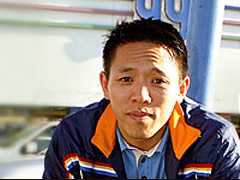
David Ngo ’00 is currently a program executive for E! Entertainment and an independent filmmaker who has just directed his first film, The Queen from Virginia: the Jackie Bong Wright Story. These accomplishments are just part of his uphill climb to make a name for himself in the film and television industry. It definitely hasn’t been easy. Where did he get his start? He got it at Ross.
1. Do you really need to start at the bottom in show business? How do you set yourself apart from the competition?
Unless they are totally hot, I think most people have to work their way up in entertainment. This is definitely true for me. My first job after graduation wasn’t even in entertainment; it was at Ross Dress for Less. I hated that job, but it made me hungrier and more passionate in my pursuit of an entertainment career. I believe passion is a big key in moving up the ladder. Talent and competence are important, but I think passion is the X-factor that makes you stand out from everyone else.
2. Whatever you did, it worked. What’s the best part of your current job?
The best part about being a programming executive at E! Entertainment is that I have a TV at my desk. I get paid to watch television.
3. You made a film. Can you describe it?
The Queen from Virginia: The Jackie Bong Wright Story is a documentary that chronicles the dynamic journey of Jackie Bong Wright, who became the first Vietnamese-American woman to ever compete in a national beauty pageant for women over 60 called Ms. Senior America.
4. Why this story?
Jackie Bong Wright is my aunt, and she taught me about the Ms. Senior America pageant. When I learned that she was headed to nationals after winning her state pageant, I was instantly hooked. I can’t really explain why, but I just knew I had to tell this story. Once we began filming, I discovered that my Aunt Jackie also has an amazing life story as a Vietnam War survivor, refugee and social activist. The other pageant contestants whom we filmed during production were simply fabulous. It was just awesome to see all of these women celebrate, live and enjoy life. Growing old is definitely cool.
5. What did you want to accomplish with this film?
I’ve taken this film one challenge at a time. Find a great producer, assemble a talented crew, raise enough money to shoot and edit the film, and get it played at festivals. We accomplished all these things, and we won Best Documentary Feature prize at the VC Filmfest: The Los Angeles Asian Pacific Film Festival. Now, we’re working to secure distribution for a 2007 release. This is the final challenge we have left to achieve. It’s been a great ride so far.
6. Describe the process of getting this project going.
The most important first step was finding an amazing producer. Luckily, I got veteran producer Katy Chen, who I knew from E! Entertainment. We combined our resources and assembled the production crew, led by our cinematographer Gavin Wynn and editor Stacy Halbach. With the team in place, it was time to raise as much money as possible. We went completely low-budget, grassroots-style on this film, so we hit up family members and friends for private donations.
7. Any hints on getting funding?
Raising money in independent filmmaking is ridiculously hard! You have to sell your soul. I think one key to finding funding is to directly appeal to people in ways that best meet their interests. We also held a big pre-production raffle and silent auction. My grandma bought a lot of raffle tickets and ended up winning most of the prizes.
8. What is one thing you know now that you wish you’d known when you started this process?
I wish I had truly known how laborious, difficult and expensive the music licensing process is for independent films. Beware of this if you plan to feature any sort of commercial music in your movie. Start the music licensing process as early as possible and set aside lots of money in your budget for that.
9. What is the biggest difference between the mainstream and independent sides of the film industry?
In the mainstream world, you get more resources but less control over your work. In the independent world, you get no resources but more control.
10. If you could change one thing about the film industry, what would it be?
Some of the best films and most diverse filmmakers out there never get a chance to dance on the big stage. I would like to see more people get their opportunity to shine. I mean, I liked Bring It On, but do we really need to see Bring It On Again, Bring It On Once More and Bring It On One Last Time?
11. Do you have any plans for future films?
Right now, as I’m finishing up work on The Queen from Virginia, I am writing a script for a comedy feature. Hopefully, it will be funny and someone will give me several million dollars to direct it.
Our Proud Partners


